Higher and Lower
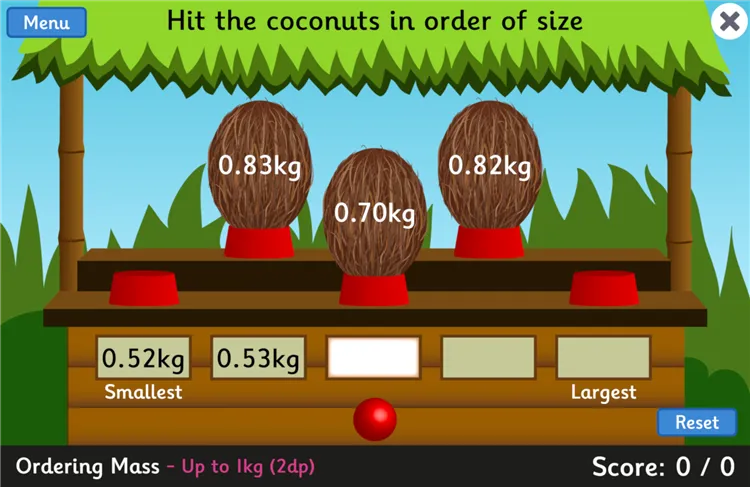
How good are you at ordering numbers? Lots of examples to try from simple ordering numbers to 10 to fractions, decimals or negative and positive numbers.
Rocket Rounding
A multiple choice game involving rounding numbers to ten, a hundred and to a whole number. There are two options, one with a number line and the other more difficult level, without one.
Part-Part-Whole
This teaching tool is useful for demonstrating 'Part-Part-Whole Model' for addition and subtraction particularly on an interactive whiteboard. Select which manipulatives you want to use and easily change your choice by pressing the 'change' button.
Ten Frames - 1 to 100
This manipulative is great for demonstrating two-digit numbers, ten more or less, one more or less and addition of two digit numbers.
Subtraction Grids
Can you meet the challenge to see how many subtraction calculations you can do in two minutes? There are different levels and you can choose either one or two missing numbers to make your number sentence correct.
Add and Subtract on a Number Line
Try adding and subtracting near multiples on a number line. Develop mental methods of addition and subtraction by adding and subtracting a multiple of 10 or 100, and then adjusting. Works well on IWB.
Caterpillar Ordering
A game for ordering and sequencing numbers. It has a wide range of levels including ordering the first five numbers, all the way up to 1000 and negative and decimals numbers. Sequencing levels include multiples and counting in steps up to 10.
Today's Number (to 20)
Our Today's Number game can help early years children to learn the numbers to 20 in a fun way. The various activities help with number formation, recognition, ordering and counting.
Loop Cards
Loop cards can help to improve your mental maths. Complete the loop against the clock. All types of calculations. You play the game similar to dominoes. NB The 75% section is faulty.
Using Numbers on a Number Line
An excellent podcast with ideas for improving children's understanding of number lines and how teachers can draw out pupils' reasoning skills, use of language and the beginning of understanding proportion.